Detrusor underactivity (DU) remains a challenging lower urinary tract dysfunction with limited pharmacologic therapies. Androgen receptor (AR) signaling regulates smooth muscle plasticity and mitochondrial function. This study investigated whether the selective androgen receptor modulator (SARM) LGD-4033 could improve bladder contractility in a rat ischemia-induced DU model and whether its effects were AR-dependent.
Female Sprague-Dawley rats were divided into five groups (n=3-5): Control, DU, DU+SARM (10 mg/kg/day), DU+SARM+ Enzalutamide (ARPI, AR pathway inhibitor), and DU+ARPI. DU was induced via bilateral iliac artery partial ligation. After 4 weeks, cystometric analysis assessed maximum voiding pressure (Pmax). Bladder tissue was analyzed for smooth muscle contractile proteins (MYL, MYH11) and stress markers (NDRG2, MLK2) via Western blot.
DU significantly reduced Pmax compared to control (0.447±0.226 vs 1.048±0.071, 57% reduction). SARM dramatically restored contractility, achieving 8.2-fold higher Pmax than DU (3.674±0.745 vs 0.447±0.226, 722% increase, p<0.001), exceeding control by 250%. Enzalutamide completely abolished SARM's effect (0.408±0.055), returning Pmax to DU levels and confirming AR-dependence. Western blot showed SARM modestly increased MYH11 (1.27-fold) with minimal changes in stress markers NDRG2 and MLK2, suggesting functional improvement without cellular stress activation.
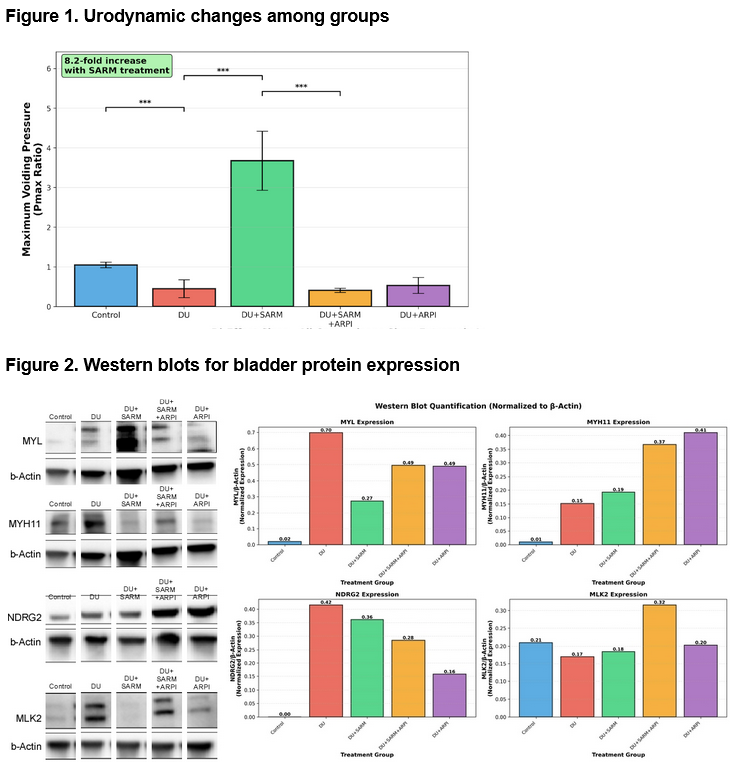
Selective androgen receptor modulation dramatically improves bladder contractility in ischemia-induced DU through AR-dependent mechanisms. The 8-fold functional restoration represents a clinically meaningful improvement. These findings support SARMs as a promising therapeutic strategy for DU, particularly in aging or post-ischemic bladder dysfunction.