Little is known regarding medical retreatment rates after water vapor thermal therapy (WVTT; Rezum, Boston Scientific, Marlborough, MA) for benign prostatic hyperplasia (BPH). We sought to identify incidence and predictors of medical retreatment for symptomatic recurrence among this population.
We performed a single institution retrospective review of patients who underwent WVTT by a single surgeon from July 2018 to January 2024. We excluded patients with prostate volume >80cc. Primary outcome was medical retreatment, defined as initiation or resumption of any BPH medication following WVTT.
We identified 155 patients with mean age 67.4 + 10.3 years and prostate volume 46.4 + 13.6 cc. 48 (31%) patients underwent medical retreatment within mean follow up of 19.5 months. Mean time to retreatment was 9.8 months. Alpha blockers were the most commonly restarted medication (40.5%), followed by daily tadalafil (25.5%) and 5-alpha reductase inhibitors (ARI; 10.6%); 23.4% of patients restarted multiple medications. Preoperative use of alpha blockers (95.8% vs 84.1%; p=0.040), 5-ARI (39.6% vs 23.4%; p=0.038) and daily tadalafil (35.4% vs 15.0%; p=0.004) significantly predicted medical retreatment. At 3 months, IPSS total (15.5 ± 7.9 vs 9.8 ± 6.1, p=0.002) and QoL (3.2 ± 1.6 vs 2.4 ± 1.5, p=0.049) were significantly higher in the medical retreatment group. Surgical retreatment within 3 years occurred in 9.7% of the cohort, with nonsignificant higher rates in the medical retreatment group (12.5% vs 8.4%, p=0.426).
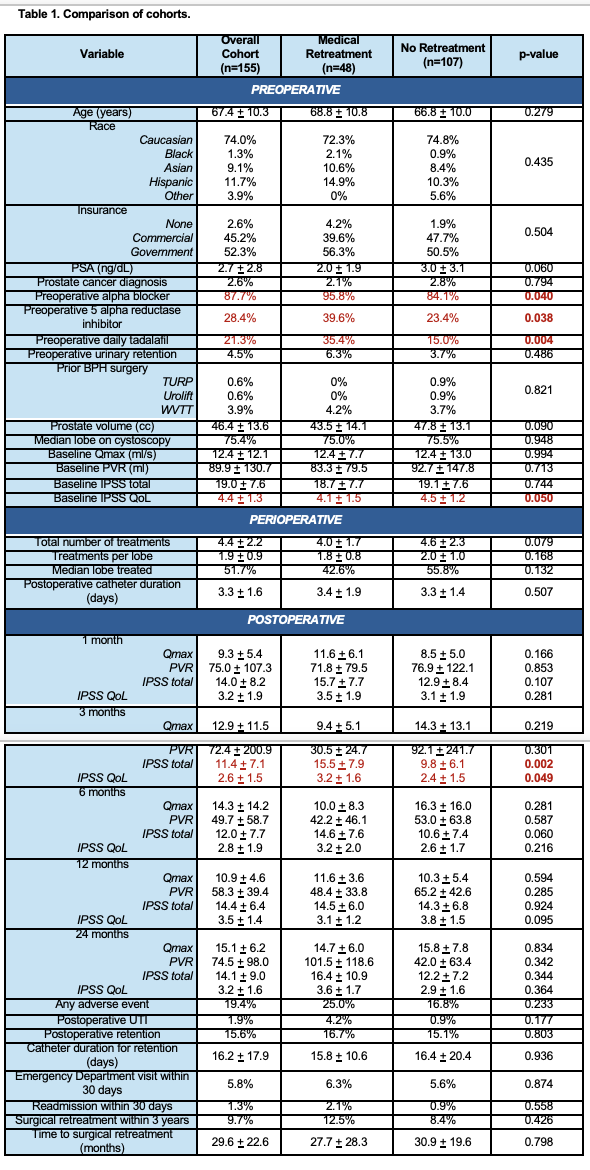
Nearly one-third of patients undergo medical retreatment after WVTT, often within the first year. Early symptom trajectory, preoperative medication use, and close follow-up may help identify patients at risk and improve long-term outcomes.